Contact Information
Biography
Not currently accepting Ph.D. students or applications for postdoctoral supervision.
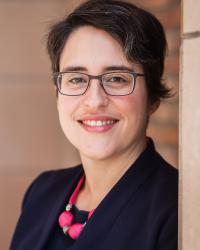
Jennifer Dubrow is Associate Professor in the South Asia program in Asian Languages and Literature, and Adjunct Associate Professor in English at the University of Washington. She focuses on Urdu literature, print culture, history of the book, global modernisms, and postcolonial literature. By combining literary analysis with attention to historical change and material aspects of print publication, her research locates modern Urdu literature within local and global contexts. Her current research investigates the relationship between aesthetics, politics, and technology.
Dubrow's first book, Cosmopolitan Dreams: The Making of Modern Urdu Literary Culture in Colonial South Asia (University of Hawai'i Press, 2018; Permanent Black, 2019), argued that the arrival of affordable print technology enabled the formation of an Urdu cosmopolis in colonial South Asia. By focusing on Urdu-language novels, satire, and the periodicals Avadh Akhbar and Avadh Punch, Dubrow shows how readers and writers claimed a shared space and affiliation on the basis of language, rather than religion, region, caste, or class. This formation, which she terms the Urdu cosmopolis, soon fractured and risked being broken by the forces of nationalism and communalism.
She is currently completing a book manuscript, Formal Disjuncture: Urdu Leftist Modernism in 20th-Century South Asia, on the relationship between aesthetics and politics in Urdu literature from the 1930s to the 1950s. The book identifies a leftist modernist literary practice in Urdu, in which avant-garde literary techniques were joined to a project of awakening the masses toward a more equitable future. It covers the work of well-known writers Sajjad Zaheer, Rashid Jahan, Saadat Hasan Manto, Krishan Chander, and Qurratulain Hyder, and uses an intermedial approach to consider literary modernism in the light of cinema and radio.
Her co-edited special issue of Modernism/modernity (2025) on The Language Challenge: Modernisms in Multilingual South Asia, argues that South Asian modernisms cannot be understood without reference to language politics and processes of vernacularization, yet languages themselves remain unstable, uncanny, and unknown.
Her most recent and in-progress publications consider the relationship between modern Urdu aesthetics and technologies such as photography, radio, and cinema.
Research
Selected Research
- Jennifer Dubrow and Preetha Mani, "The Language Challenge: Modernisms in Multilingual South Asia," Modernism/modernity 32:3 (2025): 393-407. Introduction to special issue.
- Jennifer Dubrow, "The Imagist Ghazal: Urdu Modernism and Japan," Modernism/modernity 32:3 (2025): 409-435.
- Jennifer Dubrow and Preetha Mani, eds. The Language Challenge: Multilingual Modernisms in South Asia. Modernism/modernity 32:3 (September 2025).
- Dubrow, Jennifer. "Saadat Hasan Manto and the Poetics of the Urdu Short Story," in The Oxford Handbook of Modern Indian Literatures, edited by Ulka Anjaria and Anjali Nerlekar (Oxford: Oxford University Press, 2024): 618-633. DOI: https://doi.org/10.1093/oxfordhb/9780197647912.013.33. Volume is Winner of the 2025 René Wellek Prize for Best Edited Collection, American Comparative Literature Association (ACLA).
- Dubrow, Jennifer. Review of Megan Robb, Print & the Urdu Public: Muslims, Newspapers, & Urban Life in Colonial India, The American Historical Review 128:3 (2023), pp. 1428-1429.
- Dubrow, Jennifer. Review of Neetu Khanna, The Visceral Logics of Decolonization, Critical Inquiry (2021). https://criticalinquiry.uchicago.edu/jennifer_dubrow_reviews_the_visceral_logics_of_decolonization/
- Julia Chatterjee. "Beyond Frivolity and Fantasy: Explorations of the Occult, Sorcerous, and Divine in Dastan-e Amir Hamza." MA Thesis, University of Washington, 2020.
- Dubrow, Jennifer. "Singing the Revolution: India's Anti-CAA Protests and Faiz's 'Hum Dekhenge.'" Positions: Asia Critique (2020). http://positionswebsite.org/eikon_2dubrow/
- Dubrow, Jennifer. "The Aesthetics of the Fragment: Progressivism and Literary Modernism in the Work of the All-India Progressive Writers' Association." Journal of Postcolonial Writing 55, no. 5 (2019): 589-601. DOI: 10.1080/17449855.2019.1635846.
- Dubrow, Jennifer. Cosmopolitan Dreams: The Making of Modern Urdu Literary Culture in Colonial South Asia. Honolulu: University of Hawaii Press, 2018. Print.
- Dubrow, Jennifer. "Sharafat and Bhal Mānsī: a new perspective on respectability in Fasana-e Azad." South Asian History and Culture 9, no. 2 (2018): 181-193. DOI: 10.1080/19472498.2018.1446796
- Dubrow, Jennifer. Cosmopolitan Dreams: The Making of Modern Urdu Literary Culture in Colonial South Asia. Honolulu: University of Hawai'i Press, 2018 (forthcoming).
- Dubrow, Jennifer. "Serial Fictions: Urdu Print Culture and the Novel in Colonial South Asia." Indian Economic and Social History Review 54, no. 4 (2017): 403-422.
- Dubrow, Jennifer. "A Space for Debate: Fashioning the Urdu Novel in Colonial India." Comparative Literature Studies 53.2 (2016): 289-311.
- Dubrow, Jennifer. "Khwaja Haydar Ali Atish." Encyclopaedia of Islam, Three. Leiden: Brill, 2015. 32-33. Print.
- Jennifer Dubrow, trans. "A Tarji'-band from the Avadh Panch, 1880." 2008.
- Jennifer Dubrow, trans. An Excerpt from Fasana-e Azad by Ratan Nath Dar 'Sarshar' (1846-1902). 2008.